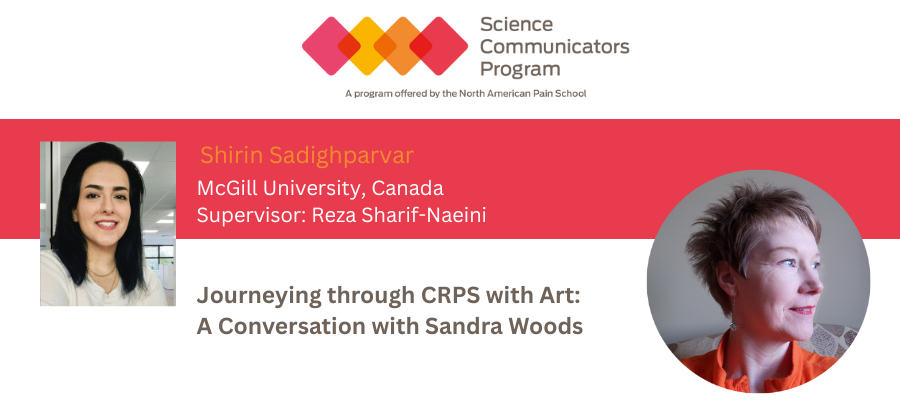
Journeying through CRPS with Art: A Conversation with Sandra Woods
Editor’s note: The 2025 North American Pain School took place June 22-27, 2025, in Montebello, QC, Canada, where four NAPSters also took part in the NAPS Science Communicators Program. This initiative helps the next generation of pain researchers and clinicians excel at communicating their own research and that of others to diverse audiences. As part of the program, participants interviewed visiting faculty and patient partners. Below is an interview with NAPS Patient Partner Sandra Woods, conducted by Shirin Sadighparvar, one of this year’s Science Communicators.
Sandra Woods is a 2025 NAPS Patient Partner and an artist living with complex regional pain syndrome (CRPS). She is also a veteran of the Royal Canadian Air Force, serves on the Canadian Pain Society’s Art Awards subcommittee, and collaborates with scientists at the Alan Edwards Centre for Research on Pain (AECRP).
In this interview, she speaks with NAPS Science Communicator Shirin Sadighparvar, a graduate student at McGill University, Montreal, Canada, to discuss her use of art to navigate CRPS, including her creation of #ArtDespitePain. What follows is an edited transcript of their conversation.
I’ve followed your CRPS journey, including your #ArtDespitePain initiative, and your story is so inspiring. Could you share how pain and art became so deeply intertwined in your life?
That’s a great question. I never painted or did any drawing or sketching before I had pain. My background is in research, and when I was diagnosed with CRPS in 2016, I treated PubMed like Google. Around 2019, I started seeing research suggesting that both appreciating art, like going to a museum, and creating art could help people with chronic pain and cognitive impairment; I have both.
I’d always wanted to learn how to paint since I was very young; my grandfather was an artist, and his wife loved museums. I was taken to museums from the time I was in kindergarten and loved watercolour. So, I thought: “If the research is showing this might help, why not try?”
When I started painting in 2021, it was during the pandemic. Suddenly, world-class artists were offering classes online. I didn’t go the YouTube route; I took instructor-led classes, and I absolutely fell in love with watercolour.
When I had my first artwork in an exhibition in 2018, I was asked to provide a short text to accompany the art photograph. I used that space to explain what CRPS is and how chronic pain impacts my life. That message got people talking more than the image itself. That’s when I realized I could use my art to raise awareness about chronic pain, and that’s how #ArtDespitePain started. It later evolved to encourage others living with pain to explore creativity, not just painting, but dance, theatre, music – anything that engages the brain and can help distract from pain.
You’ve won several awards for your art, including from the Canadian Pain Society and the City of Montreal, among others. What moments of recognition have meant the most to you, and why?
The Canadian Pain Society award was my first, and it meant so much. I always say I paint because of pain, so something good has come from something bad. To win that award, specifically from the pain community, was incredibly meaningful. That’s why I now serve on the Canadian Pain Society’s Art Awards subcommittee.
But beyond awards, one of the most meaningful moments was this past April, when the Canada Council for the Arts, the federal arts organization, recognized me as a professional artist. I only started painting in 2021; I couldn’t draw a stick figure back then. So, to be recognized as a professional artist by 2025 – that means a lot.
That’s incredible, and very inspiring. It shows others that it’s never too late to discover a new passion.
Exactly. Many people with chronic pain are in midlife or older. It’s never too late to learn something new, and you never know – you might fall in love with it, like I did with painting.
I paint too, mostly with acrylic and oil. I really admire how delicate and unpredictable watercolour is. What made you choose watercolour, especially while living with CRPS?
My grandfather worked with oil pastels, and they’re very messy; he wore gloves and a mask. I have severe asthma, and I’ve been on a ventilator three times because of it, long before COVID. So, I didn’t want to bring any solvents or strong-smelling materials into my home.
Watercolour, by contrast, just needs pigment – basically powdered colour in a gum Arabic solution – and water. That’s it. It’s also portable. When I go cycling, another way I manage pain, I can stop and paint off the back of my bicycle. All I need is water.
Much of your art is inspired by nature. How do those small moments, like sunlight on a flower or spotting wildlife, connect to your experience of pain?
There are a few layers to that. My dad was a Navy veteran and a nature lover. He taught us to stop and appreciate small beauties: flowers, trees, animals. His dad, my grandfather, was the painter. So artistic appreciation ran through the family.
For me, being in nature is meditative. When I’m painting a flower or an animal or a tree, I’m fully focused. That mindful attention becomes a form of meditation; it grounds me. Nature connects me to good memories of childhood and to my father; that grounding and mindfulness help me manage the pain.
It’s such a natural need, to feel grounded in nature.
Exactly. And with a last name like “Woods,” maybe it was meant to be!
You’ve also spoken about painting with CRPS in your dominant hand and navigating brain fog. How do you prepare mentally, emotionally, and physically to create under those conditions?
First, I want to clarify the difference between brain fog and mild cognitive impairment. Brain fog is like forgetting where you put your keys. Mild cognitive impairment, for me, is standing outside your own house with the keys in hand and not knowing how to open the door.
Both affect me. One strategy that really helps is exercise. Aerobic activity has a huge effect on both my cognition and my pain. That’s one reason I paint during cycling breaks or use my exercise bike before big meetings or painting sessions. It sharpens my focus and helps me manage symptoms.
Art has allowed you to tell the story of pain in ways words can’t. Is there a painting you’ve created that holds a deeper or hidden story you’ve never shared publicly?
Honestly, not really. I’m very open about my work because I use my paintings to raise awareness. For example, at this year’s Canadian Pain Society meeting, I exhibited a piece called Pain Waves. It was part of a series, and while I painted it specifically for that audience, it also resonated more broadly.
The same painting won second prize at a Montreal art exhibition that wasn’t about pain. It was also accepted into a national juried show with the Canadian Society of Artists. The description always stays the same: it’s about pain. People email or message me asking about the connection between that painting and pain; that opens conversations.
If someone saw your artwork without any context, what would you hope they feel or think first?
I hope they’d have questions. I studied philosophy, so I love questions. I hope people wonder: What’s this about? Why did she paint it that way? Is there a message here? Curiosity drives connection, just like in this conversation.
You recently co-presented at PAINtalks with my friend, Dr. Zoha Deldar. What was that experience like, and what did it teach you about bridging neuroscience and lived experience?
I have so much respect for Zoha. She had to advocate hard to get PAINtalks to allow a co-presentation, and not just that, but a co-presentation with a patient. It was the first in their history.
It taught me that even when something seems impossible, it might just take the right push to make it happen. And it also showed me that research becomes more impactful when people can connect with the story behind it. Storytelling, whether in research communication, media, or funding, makes science more human. That’s what connects people.
As someone who’s worked with scientists, including at the Alan Edwards Centre for Research on Pain, what could researchers like me do better when collaborating with patient partners?
All of you at NAPS are already doing the right thing; you’re here, learning. I spoke to Dr. Kirsty Bannister about this recently. In the UK, they involve patient partners from the very beginning, even in basic research. I think some scientists feel their work is too far from clinical application to involve patients. But if you talk to people with conditions like CRPS, we can offer ideas for research questions or hypotheses that might not occur in conversations among researchers alone.
That can ultimately benefit your career, your grant writing, and the quality of your research. If you can show you’re addressing real patient concerns, it strengthens your case. Everyone benefits: researchers, patients, and the field as a whole.
Is there an upcoming project you’re excited about?
Yes! I’m launching a new initiative in Montreal that brings together chronic pain and art. It’s called the West Island Art Studio Circuit, and it’ll be an annual event. I’m organizing it as a “disabled artist” due to my cognitive impairment.
We’re starting with about a dozen artists; each opening their studios for a public Open Studio Day. Then we’ll host an exhibition in September at a local café in Pointe-Claire: an unplugged – computer-free – space known for conversation.
The goal is to make art more accessible and to build stronger connections between artists and the community. Since many of my paintings are about chronic pain, I always include an awareness section. Often at art fairs, I end up talking more about pain than art, because people want to understand.
Sometimes someone will say, “I have arthritis. Do you think painting could help me?” Then I ask them, “Do you like dance? Music? Theatre?”
That’s such a beautiful way to open dialogue and offer connection.
Exactly. Pain can mean different things to different people. I once spoke to someone who had lost her mother, and she connected with my work through that grief. For us at NAPS, we think of pain in terms of nervous system signals, but emotional pain is just as valid in people’s lives. My goal is always to help someone, anyone, get through something.
And I’d like to add: Many people see patient partners as “just” patients. But we often bring other expertise, too. I worked in research ethics and coordinated epidemiology projects. I’ve helped researchers with manuscript prep and even fundraising. Patient partners can be powerful collaborators, on many levels.
Thank you so much, Sandra, for sharing your insights, your story, and your time. This has been deeply inspiring.
Thank you! It’s been a pleasure.
Consent management
Your privacy is a priority for us. We therefore need your consent for the website to use cookies. These cookies are useful for facilitating your browsing, analysing site usage and producing statistics. You can set cookies and withdraw your consent at any time.
Functional
Always active
The technical storage or access is strictly necessary for the legitimate purpose of enabling the use of a specific service explicitly requested by the subscriber or user, or for the sole purpose of carrying out the transmission of a communication over an electronic communications network.
Preferences
The technical storage or access is necessary for the legitimate purpose of storing preferences that are not requested by the subscriber or user.
Statistics
The technical storage or access that is used exclusively for statistical purposes.The technical storage or access that is used exclusively for anonymous statistical purposes. Without a subpoena, voluntary compliance on the part of your Internet Service Provider, or additional records from a third party, information stored or retrieved for this purpose alone cannot usually be used to identify you.
Marketing
The technical storage or access is required to create user profiles to send advertising, or to track the user on a website or across several websites for similar marketing purposes.