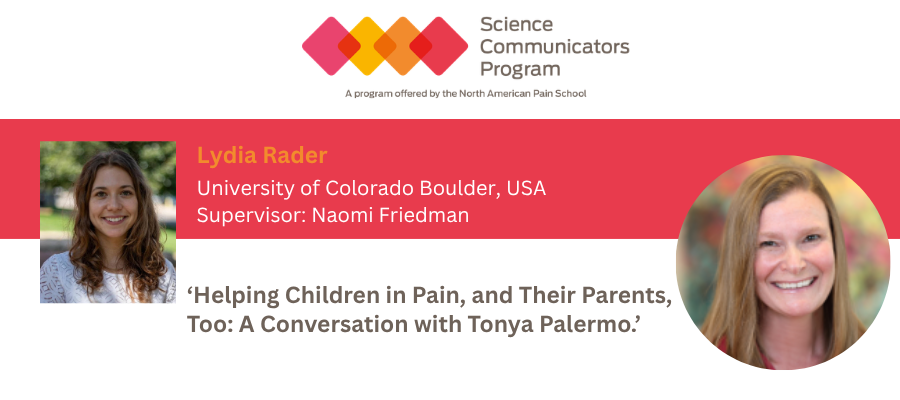
Helping Children in Pain, and Their Parents, Too: A Conversation with Tonya Palermo
Editor’s note: The 2026 North American Pain School took place June 28 – July 3, 2026, in Montebello, QC, Canada, where five NAPSters also took part in the NAPS Science Communicators Program. This initiative helps the next generation of pain researchers and clinicians excel at communicating their own research and that of others to diverse audiences. As part of the program, participants interviewed visiting faculty and patient partners. Below is an interview with visiting faculty member Tonya Palermo, PhD, conducted by Lydia Rader, PhD, a postdoctoral associate at the University of Colorado Boulder and one of this year’s Science Communicators.
Dr. Tonya Palermo, PhD, is Professor of Anesthesiology and Pain Medicine at the University of Washington School of Medicine, where she holds the Hughes M. and Katherine Blake Endowed Professorship in Health Psychology and serves as Vice Chair for Research, with adjunct appointments in Pediatrics and Psychiatry. She is also Director of the Center for Child Health, Behavior and Development at Seattle Children’s Research Institute and leads the Pediatric Pain & Sleep Innovations Lab.
Her research focuses on the behavioral, psychosocial, and family factors that shape pediatric chronic pain, and on the interrelationship between sleep and pain. She is also a leader in developing and implementing innovative psychological interventions, including mobile-delivered cognitive-behavioral therapies, to manage and prevent chronic pain in children.
Dr. Palermo is also Editor-in-Chief of The Journal of Pain and the author of two books on cognitive-behavioral therapy. She is also deeply involved in training the next generation of clinician-scientists, including directing the University of Washington’s T32 postdoctoral training program in anesthesiology research.
You initially trained as a clinical psychologist and are now in the Department of Anesthesiology and Pain Medicine at the University of Washington. Could you share how your journey began and what led you to pediatric pain?
I had what’s probably an unusual path into this. As an undergraduate, I was looking for a job and found one at the UCLA Medical Center, in the pediatric pain program led at that time by Dr. Lonnie Zeltzer. Unbeknownst to me then, she was a major figure in pediatric pain management and ran one of the first multidisciplinary pediatric pain programs in the country. That exposure really piqued my interest in pediatric pain. It shaped what I wanted to do in graduate school, and I was fortunate to be able to keep a focus on pain throughout my training. I think getting into the field that early has been a unique vantage point — I’ve gotten to watch it evolve over the course of my career, from a fairly narrow, biomedical view of pain to the much broader, interdisciplinary approach we take today.
Chronic pain in children and adolescents is more common than many people realize. Were there misconceptions when you first got into the field, and how much has that shifted?
It’s changed enormously. I was first exposed to pediatric pain in the 1990s, and at that point there were very limited epidemiological data on childhood chronic pain. Even establishing basic prevalence was a real challenge, and that gap fed a myth, or just misinformation, that chronic pain wasn’t common in young people. That has shifted dramatically since, with far more attention now given to characterizing chronic pain in childhood.
There were so few people in the field back then. One of the key figures who helped shift our understanding of the impact of chronic pain was Dr. Lynn Walker, who created the Functional Disability Inventory in 1991 — one of the first tools to ask not just whether a child had pain, but what that pain actually disrupted in their daily life. I got really interested in that instrument, because it reframed the question in a way that was new at that time: Beyond pain intensity, how should we be thinking about functional impact? That’s what pulled me toward studying how we measure the functional consequences of chronic pain.
Since many people may picture pain as a purely physical experience, how would you explain to a skeptical parent or a patient that a psychologist, and not just medication, can help reduce pain?
There are a lot of metaphors that have been used in pain education to help both children and their parents understand that pain has different influences, including psychosocial factors, and these are targeted in a range of treatments. When I used to see patients clinically, one of the analogies we would use was sports. I’d ask a kid if they played a sport, soccer, say, and we’d talk it through: “Have you ever gotten injured in a game, and did you keep playing afterward?” A lot of times the kid would say, “Yeah.” Or the parent would say, “Yeah, they kept going.” And then the moment they got in the car, they’d start crying and become aware of the injury, “Oh, I got hurt.”
That’s a nice everyday illustration of descending pain modulation – the brain’s ability to turn pain signals up or down depending on what else is going on. So we’d talk about what kept them going while they were still playing. It’s because they were motivated to win the game, and that motivation was tied up in the social moment – teammates counting on them, their parents watching. I’d try to get them to talk through what was actually driving that. Sometimes it was the cheering, sometimes it was seeing their parents’ faces. That combination of motivation and social context can trigger the body’s own pain-relieving response, raising the pain threshold while attention is elsewhere. Once the game ends and that pull fades, the pain finally registers.
That distinction — between the injury itself and when pain is actually felt — often helps families understand that pain isn’t just a fixed readout of tissue damage; pain can change depending on attention, mood, and motivation. I think it’s worth building a small library of examples like this that families can relate to, so they really internalize that pain is malleable, not fixed.
You’ve pioneered digital therapies for kids’ pain. What drew you to that work?
My initial interest in digital interventions began when I was living in a very underserved area in Oregon, and we had patients who would drive six hours to Portland for an appointment in our pediatric pain clinic. It was disheartening to practice as a psychologist and think about the burden that one appointment placed on those families. I thought there had to be a better way for them to access the strategies we wanted to teach — a way to take what we do face-to-face using cognitive behavioral therapy [CBT] principles and turn it into something children and parents could use at home, at their own pace, without the burden of travel.
My early versions used many of the same worksheets I’d been using in face-to-face treatment, just transformed for digital delivery. Along the way, I got a lot of input from children and parents about how the information was presented and what they wanted to see. That input was critical for keeping it brief while still covering the areas we needed to, and for building in not just education but actual skills training and practice opportunities. That’s the key difference between CBT and education alone: You need chances to practice a skill, and you need feedback on whether it’s actually helping.
That was some of our early work. At the time, I’d see patients clinically and give them assignments from our web-based tool: “Let’s space out our next follow-up, over the next month, go through modules two and three, and we’ll talk about it when you come back.” It let me run a kind of hybrid model, where I didn’t need to see them in person as often. We were also studying the intervention in trials at the same time. Since then, we’ve done a lot of work to turn it into a mobile app, once smartphones came out and it was clear that’s where most kids already were. It’s evolved from there.
Were there any unexpected setbacks when you were first developing this digital intervention?
More than a setback, I’d say that because I did this early, when the technology was just developing, there were things we simply didn’t know yet about digital delivery. The very first digital thing I did was a pain diary. We used a Palm Pilot – this was so long ago you may not even know what that is – a little handheld device often used for calendaring and simple organizational tasks. We built a customized diary and had kids fill it out at home. My initial idea, because I didn’t really understand the technology yet, was to deliver treatment in response to the ratings in the kids’ diaries – like if they had a pain flare there would be specific instructions and strategies sent to the kid. But the devices weren’t actually connected to the internet, so we couldn’t deliver treatment dynamically in response to kids’ entries. I had all these ideas and then realized you couldn’t do that. We needed a different technology solution.
A lot of it was just learning along the way. I’m not a technology person per se, and I have no advanced technical background, but I was always drawn to the question of how we could bring these strategies to kids who don’t have good access to in-person care. That question led to a lot of trial and error with different technologies. Along the way, I learned about a few other researchers doing similar work delivering behavioral interventions digitally. One of the first people I met who really influenced me was Dr. Lee Ritterband, a psychologist in Virginia. He’d built a digital intervention for kids with encopresis [when a child passes stool in places other than the toilet], and it had this hilarious name: ‘UCanPoopToo.’
That is hilarious.
I’ll never forget that. That was like 20 years ago.
That means it was a good name, right?
It was a good name; you remember it. I brought Lee in as a consultant on the first digital intervention grant I wrote, and I learned a lot from him about digital interventions. That really helped me look closely at examples of innovative interventions other people had created.
You’ve talked about increasing access through digital interventions, and how that’s helped reduce barriers to treatment. Beyond access, what else do digital therapies make possible that in-person care can’t?
Good question. My focus is on access, but there are also parts of digital therapies that are simply different from what you can do face-to-face. A digital therapeutic is available in the moment, when kids and families actually need it, and as a therapist, you’re not available to them twenty-four seven. That’s a different way of thinking about treatment – not just what you can pack into one hour a week or once a month, but what you could build so someone practices a little bit every day. There’s a good argument for that kind of distributed, daily practice over weeks when it comes to building a skill. It’s also made me think there are some populations for whom digitally delivered skills are probably going to land better than in-person care, especially kids with more episodic pain. They’re unlikely to schedule regular CBT appointments for pain that comes and goes. And we know there’s stigma attached to scheduling in person with a psychologist, so working through a digital tool on your own is also a way to sidestep that.
We were also able to build tools specifically for parents, which isn’t always easy to do in person. As a psychologist seeing a child and family, your attention is split, and it usually goes to the child for most of the visit. Plenty of psychologists want to give parents some skills training too, but there often just isn’t time. Having digital tools that let parents work through strategies on their own means some families may end up getting more treatment overall, not less.
I didn’t even think about the family dynamic piece of it – and that you can make this broader impact for all of the family members.
Exactly. We had parents telling us, “Oh, I shared this with my husband, and I shared this with the grandparents.” That’s when we saw the real benefit of having something concrete that parents could hand to other adults in the child’s life.
Sleep and its relationship to pain is another thread that runs through your work. How did that start?
One of the clinical programs I helped start early in my career was a pediatric sleep clinic, alongside a pulmonologist. That gave me a very broad introduction to sleep — treating kids with any kind of sleep problem, as the psychologist on a multidisciplinary team of other providers. I saw kids with sleep apnea and narcolepsy, but also kids with behavioral sleep problems such as insomnia, and I noticed that many of my patients with chronic pain had these same problems. Coming at it from that angle was interesting. Once I’d learned how to conduct a good sleep interview and picked up some sleep treatment skills, I brought that into pain clinic and thought, “Wow, all my patients have sleep problems — why aren’t we doing something about this?”
At the time, there really hadn’t been studies looking at sleep and pain together. I did a lot of initial, descriptive work trying to understand what kinds of sleep problems kids with pain have, using both objective measures – actigraphy – and self-report survey measures, and comparing what each approach could tell us. That early work pointed to something that’s now well established: Pain and sleep have a bidirectional relationship, but interestingly the relationship of sleep driving subsequent pain was stronger than the reverse. From there, the real goal was treatment, so I got interested in insomnia symptoms specifically, since that was by far the most common sleep problem. The good news about insomnia is that it’s very treatable. There are well-established protocols for adults, cognitive behavioral therapy for insomnia, or CBT-I, that can be adapted for teens. We were able to do that across a couple of different clinical trials, working to integrate insomnia treatment with pain treatment, and to test which sequence of treatment works best.
Insomnia treatment appears to be one place to begin. With so many possible treatments, if an individual is experiencing pain now, what is one thing that you would recommend or point them toward?
I do think it’s very individual, and it would be wonderful to figure out treatment needs in a better way upfront. When kids have significant insomnia, if we screen for it, we could start them there first — we know insomnia treatment helps, and it often leads to improvements in pain and disability, too. But other kids have more significant comorbidities or issues that call for a different starting point. We haven’t done much of that in pediatric pain – really thinking about how to sequence or personalize treatment around whatever the most pressing problems are, the way a stepped-care approach would. But everyone’s experience is so different.
We have a parent advisory group for our lab, and last month we were talking with parents about developing a measure of unmet treatment needs, and asking for their input. As we listed out different treatment options, a lot of parents said, “I didn’t even know that was an option.” So the first thing is just understanding what all the possible treatments are, which are effective, and which problem each one targets. Families may hear about things like acupuncture, but wonder what is that for, exactly? Is it targeting pain itself, or some associated symptom? It’s not always clear. We have so many treatments available, and there’s no real roadmap for an individual patient — where to start, and why.
I’d love to talk about your experience being editor in chief of The Journal of Pain. You do a lot to give science a platform. Has that role changed how you view your own field?
That’s a good question. The Journal of Pain is interesting to me because it’s so broad — it covers pain science as a whole, not just my own focus on pediatric pain. That’s been useful in helping me think about the field more comprehensively, and about what I can bring back to my own research. Most of us read heavily within our own specific, nuanced area, but we’re not necessarily exposed to a much broader sense of what is happening elsewhere. I think that’s a unique benefit of being an editor. The other thing I’ve tried to think about is what I want to improve in the field — the things that, through the gatekeeper role journals play, we can signpost to the field and hold people accountable for.
So, when I first started as editor, we made significant changes to our guidance on reporting around inclusion, diversity and equity — being comprehensive in reporting sample and demographic variables, using terms properly and through an inclusion lens, reflecting appropriately on study limitations, and reporting on patient and public involvement. I’ve been genuinely impressed by how much our community has stepped up. It’s been remarkable to watch that shift over the past couple of years, and how people aren’t just adhering to the guidance, they’re incorporating it into better quality work. It’s encouraging, and it’s a good reminder that journals can move the needle on quality. We tend to think of funders as the ones with leverage — that people do something because a funder requires it — but journals can push a field forward too.
What a great insight on the power of journals and editors. I see how it could snowball, too, and the peer review process itself becoming a way to teach those skills.
Exactly. And hopefully you take that feedback to the other journals that you submit to, even the ones without the same requirement. But I was proud to bring together a group of editors from other pain and anesthesia journals – first to focus on equity, diversity, and inclusion guidance, and more recently, on trustworthy pain science. Those have been genuinely valuable opportunities to talk with other pain and anesthesia journal editors. There isn’t really a forum where we normally interact, so it’s interesting to hear what your colleagues are dealing with in their own journals, what issues matter to them, and what their priorities are. It’s been a neat learning experience.
We’ve talked about where the field has been. What do you think are important future research directions for pediatric pain?
I’ll emphasize what I talked about at the North American Pain School: We can do a lot more to identify children with chronic pain earlier, look at both risk and resilience factors, and move the field toward developing prevention interventions – ideally primary prevention, catching things before chronic pain ever takes hold. We’re the ones who should be doing that work, and modeling it for pain scientists who study older populations. Pain so often begins in childhood, so we should be the ones building examples of how to implement preventive interventions well. I’d love to see the field move in that direction and have some real successes showing that we can reduce early risk factors and, over the long term, reduce the incidence of chronic pain itself.
Consent management
Your privacy is a priority for us. We therefore need your consent for the website to use cookies. These cookies are useful for facilitating your browsing, analysing site usage and producing statistics. You can set cookies and withdraw your consent at any time.
Functional
Always active
The technical storage or access is strictly necessary for the legitimate purpose of enabling the use of a specific service explicitly requested by the subscriber or user, or for the sole purpose of carrying out the transmission of a communication over an electronic communications network.
Preferences
The technical storage or access is necessary for the legitimate purpose of storing preferences that are not requested by the subscriber or user.
Statistics
The technical storage or access that is used exclusively for statistical purposes.The technical storage or access that is used exclusively for anonymous statistical purposes. Without a subpoena, voluntary compliance on the part of your Internet Service Provider, or additional records from a third party, information stored or retrieved for this purpose alone cannot usually be used to identify you.
Marketing
The technical storage or access is required to create user profiles to send advertising, or to track the user on a website or across several websites for similar marketing purposes.